
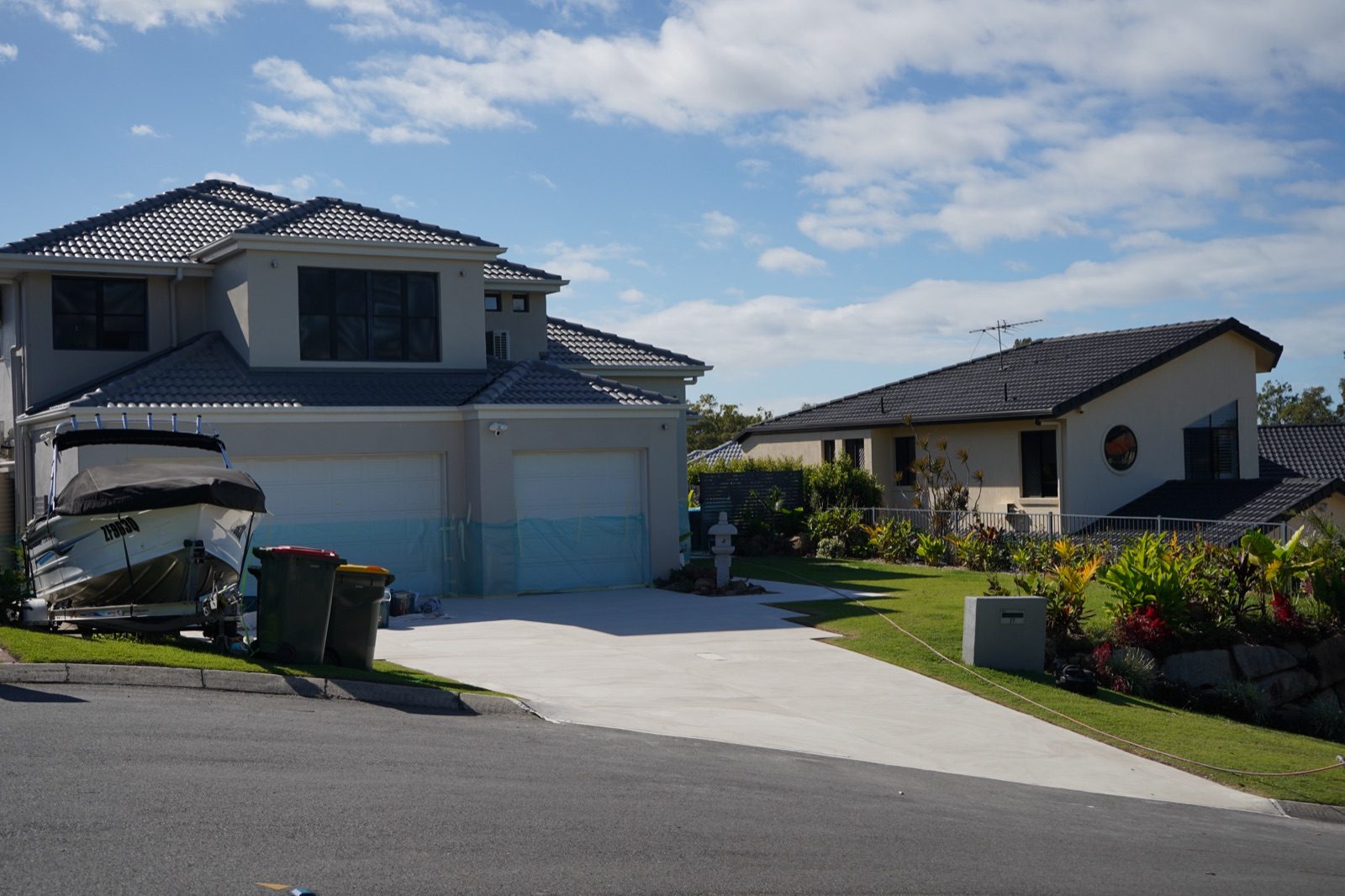
Resurface It or Rip It Out? What the Decision Actually Hinges On
When a driveway is cracked, stained or simply stuck in the decade it was poured, there are two ways to get a new surface: resurface the slab you have, or demolish it and pour a new one. Both end with a driveway you're happy to pull into. They differ enormously in cost, in how long the driveway is out of action, and in what they can and can't fix - and the right choice comes down to one question about your slab, not your budget: is the concrete underneath structurally sound?
This guide is written for Brisbane homeowners weighing that decision. It covers how to tell cosmetic wear from structural failure, what each path costs at our published rates, how long each takes, and a real job in Samford where resurfacing was the right call. For the broader Queensland pricing comparison, our spraycrete vs plain concrete cost guide goes deeper on the numbers - this article is about making the call on your own driveway.
What Each Option Actually Involves
The terms get used loosely, so it's worth being precise about the two jobs being compared:
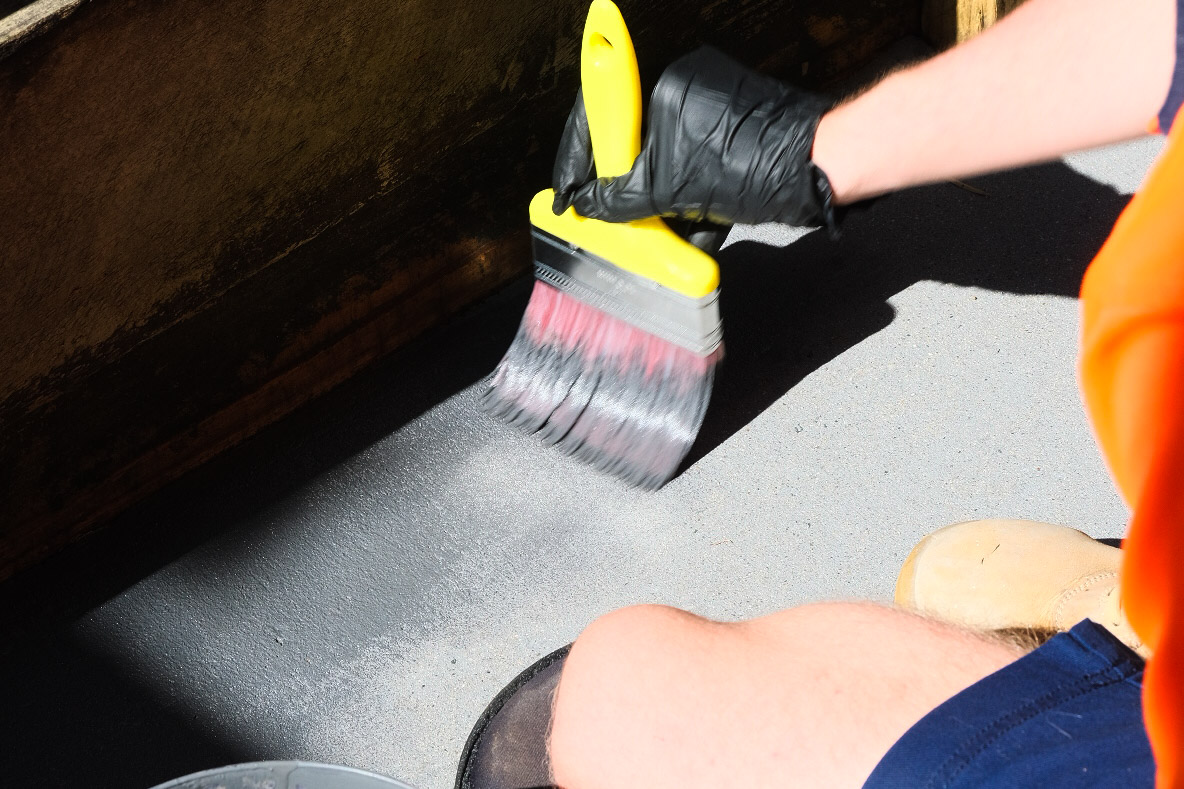
- Driveway resurfacing - also sold as spraycrete or covercrete; the terms all refer to the same process. Cracks and chips are repaired, the slab is ground and cleaned, then a polymer-modified cement overlay is sprayed over the existing concrete in your chosen colour or stencil pattern and sealed. No demolition - the old slab stays in the ground doing the structural work it was always doing.
- Full replacement - the existing slab is broken up, the rubble is carted away, and a new plain concrete slab is poured and cured from scratch. A structural job that resets the driveway completely.
That one difference - remove the slab or keep it - drives almost everything else in this comparison: the price, the timeline, and which problems each option can actually solve.
Cosmetic Wear or Structural Failure? How to Read Your Slab
Much of Brisbane sits on reactive clay soil that swells when wet and shrinks when dry. Every wet season the ground moves, and older slabs poured without decent control joints crack along whatever line the soil chooses. In suburbs built out through the 70s, 80s and 90s - Stafford, Mount Gravatt, Kenmore and plenty like them - the original concrete is now 30 to 50 years old, and it shows.
The good news: most of what makes a driveway look terrible is cosmetic. Once soil movement has settled or been addressed, a cracked slab is usually still structurally sound - it just looks rough. Decades of oil and rust staining, surface wear that exposes the aggregate, patch repairs in mismatched grey and a dated broom finish are all surface problems, and a surface problem has a surface solution.
Signs Resurfacing Will Do the Job
These are the conditions an overlay is built for:
- Cracks that have stopped moving and can be repaired during surface preparation
- Oil, rust and tannin staining from years of parked cars and storm-season leaf litter
- Surface wear that has exposed the aggregate or left the finish patchy
- A plain or dated finish that drags down the whole street front
Signs Replacement Is the Honest Answer
And these are the problems no coating can fix:
- Concrete cancer - corroding reinforcement breaking the slab apart from within
- Significant subsidence, or a base that has failed underneath the slab
- Cracking that keeps moving with the seasons rather than settling
- Major structural movement that leaves sections loose or stepped
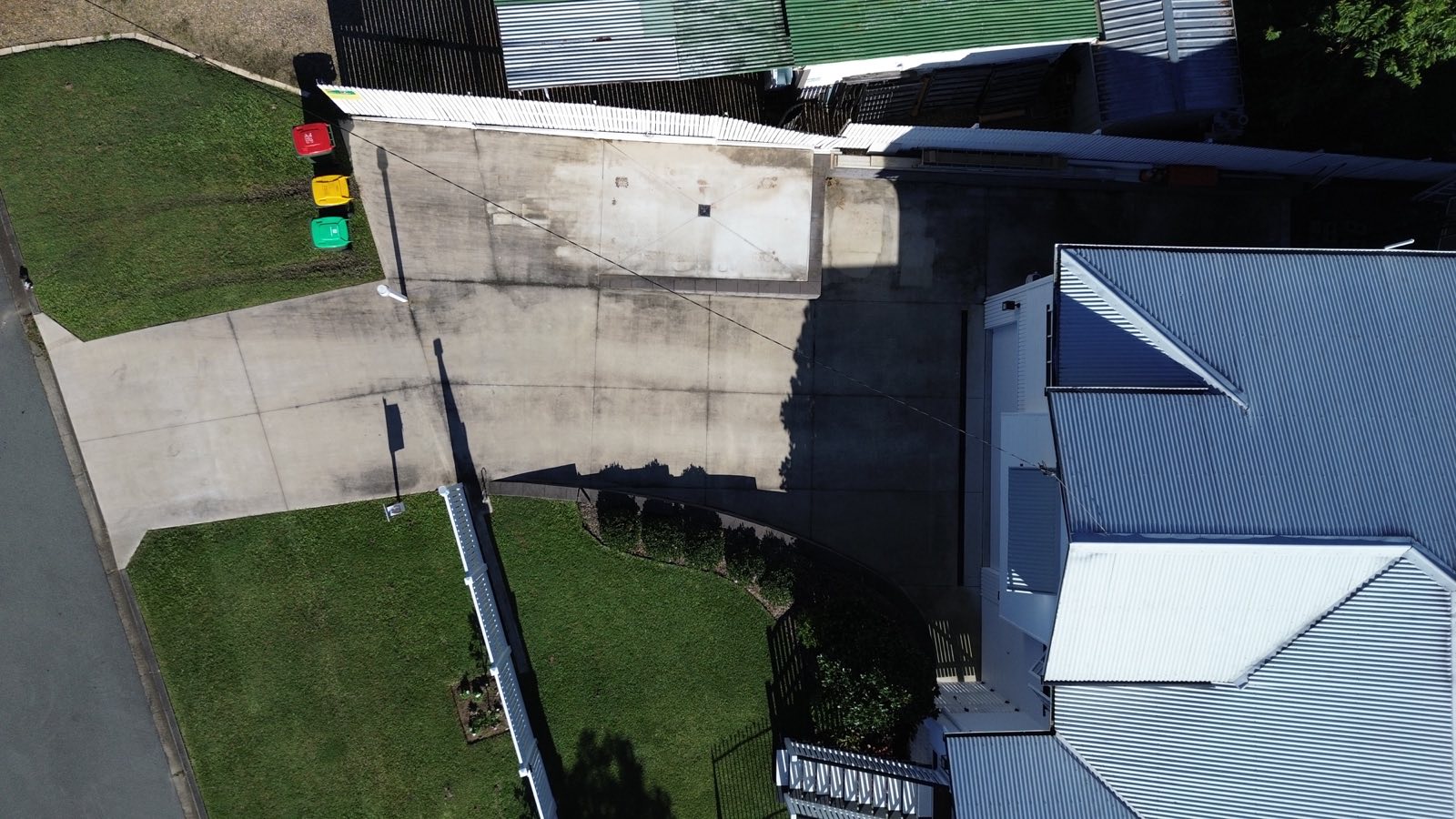
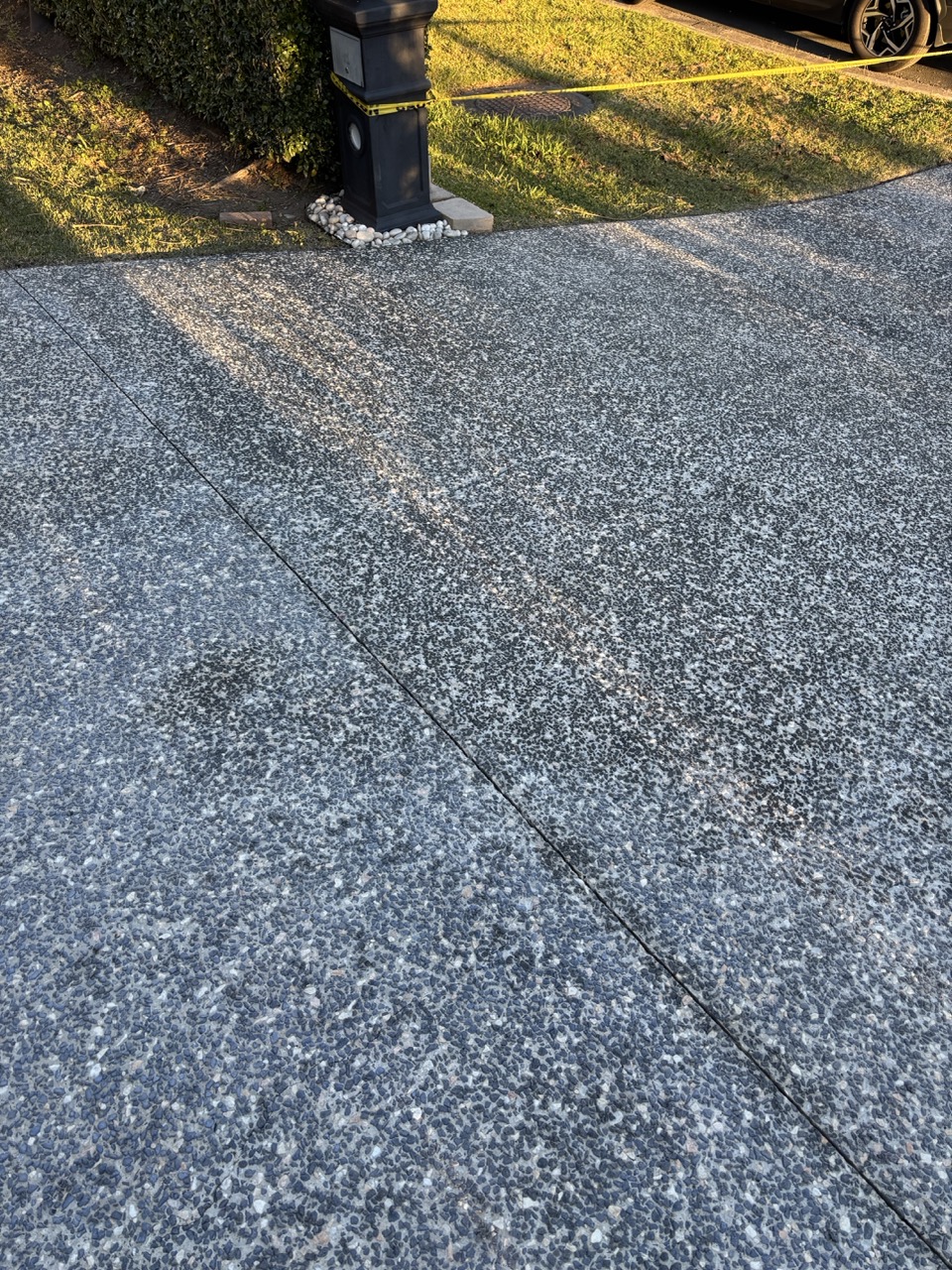
An overlay bonds to the slab underneath, so it is only ever as good as that slab. Coating over genuine structural failure just gives the failure a new colour - which is why we recommend replacement on site when that's what the concrete needs, cost aside. For the visible signs that separate genuine concrete cancer from cosmetic wear, see our guide to concrete cancer vs surface damage. The driveway below is the far more common case: worn and stained on top, sound underneath. It was resurfaced in a charcoal flake finish days after this photo was taken.
A Samford Driveway That Didn't Need Replacing
The before half of the slider below is a white weatherboard Queenslander in Samford, on Brisbane's north-western fringe. From the air, the driveway was blotchy and dark-stained - worst under the carport overhang where the cars sit - and the side hardstand wasn't much better. It's exactly the kind of surface that makes people assume the whole slab has to go.
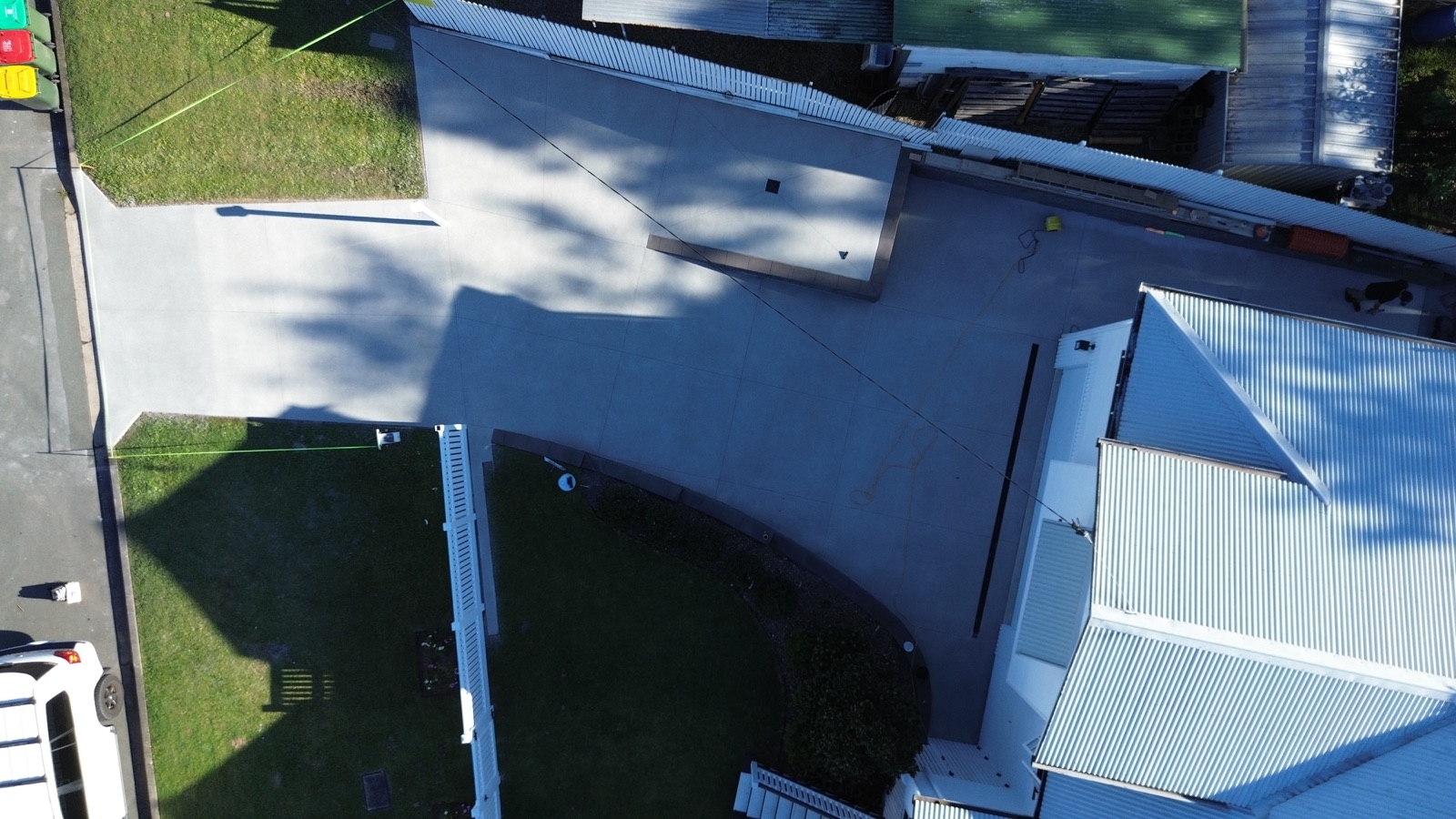
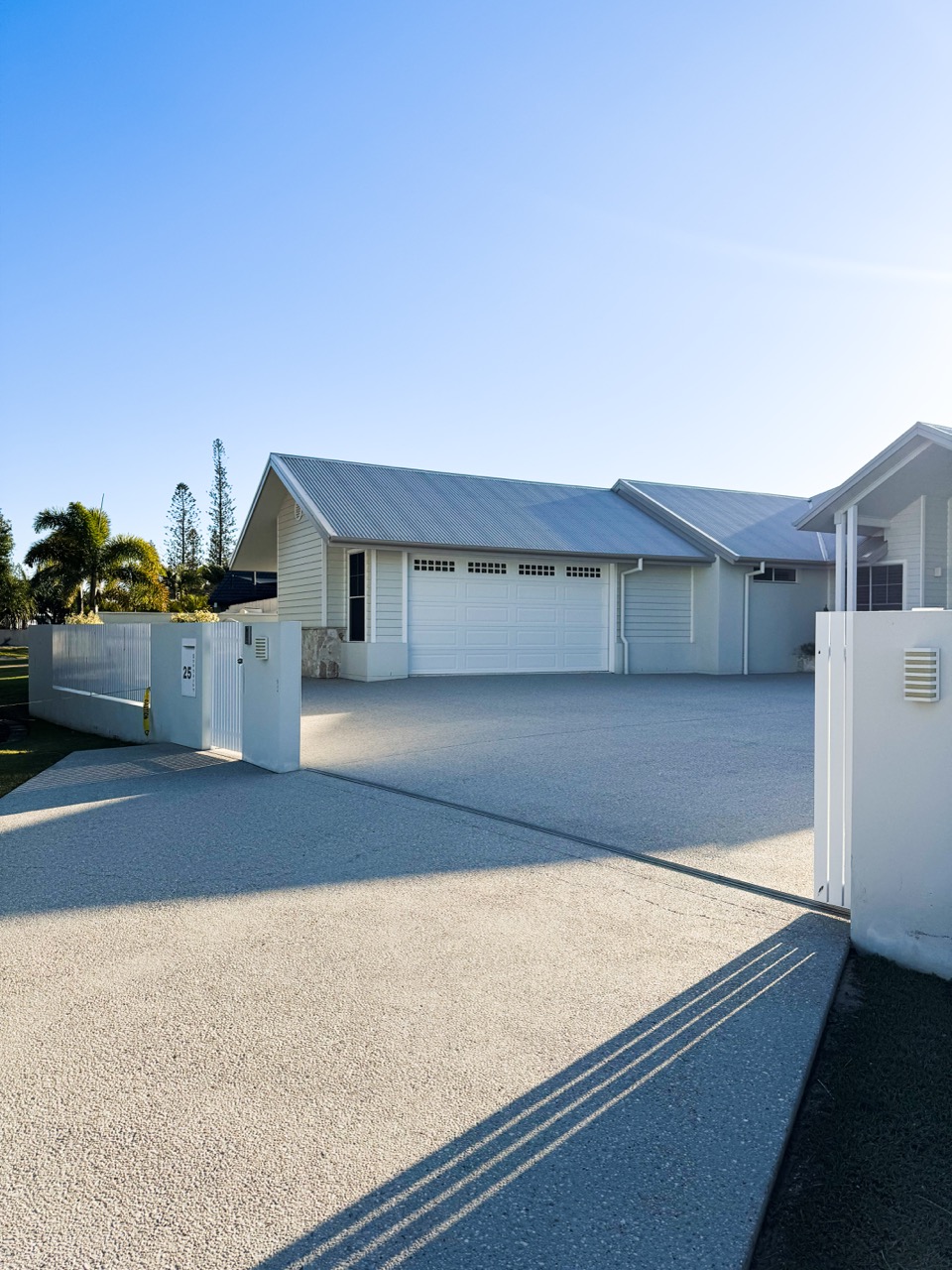
It didn't. The concrete underneath was sound, so the slab was repaired, prepared and resurfaced in Grey Stone. Two days after the before photo was taken, the same driveway ran an even pale grey from the street crossover through to the garage and the side parking bay, with hazard tape strung across the crossover while the new surface cured. Drag the handle to compare.
What Each Path Costs in Brisbane
Driveway resurfacing in Brisbane typically costs $50 to $100 per square metre including sealing, with surface condition, the finish you choose and access deciding where in that range a job lands. Full replacement starts from around $150 per square metre once demolition and disposal of the old slab are factored in - and that's before any decorative finish or sealing on the new pour.
On a standard 60m² driveway the maths looks like this: resurfaced in spraycrete, the job typically runs about $4,500 including normal preparation and sealing. Replacing the same area starts from roughly $9,000 - around twice the money for a plain grey result. Very small areas won't scale down in a straight line, because minimum job totals (from $3,500 ex GST for a standard finish) cover mobilisation and setup. For a number on your own measurements, the driveway resurfacing page has an instant calculator built in.
Days Off the Driveway, Not Weeks
Most residential resurfacing jobs take two to three days on site, depending on the size of the area, the preparation required and the weather. You can usually walk on the new surface within 24 hours, and vehicles stay off for no less than seven days from completion so the coating and sealer can fully cure.
Replacement runs on a different clock. Demolition, the pour, and the curing period before a new slab can safely take vehicle weight put the driveway out of action for weeks rather than days. One Brisbane-specific note that applies either way: overlays need dry weather to apply and cure, so from November to March we plan jobs around the afternoon storm season - most residential jobs only need a few clear days on site.
If the Slab Only Needs Protection, Neither Is the Answer
There's a third case worth naming: a slab that's structurally sound and still looks reasonable, but has lost its protection. If the surface just needs defending from UV and storm-season moisture rather than a new face, clear or coloured concrete sealing at $25-30 per square metre is the cheaper conversation again - resurfacing would be overkill.
That's the honest hierarchy: seal it if it's sound and just unprotected, resurface it if it's sound but ugly, replace it if it's structurally gone. Each step up costs more, so it's worth being sure your driveway actually needs the step you're paying for.
Getting a Straight Answer on Your Driveway
The decision rests on what your concrete is actually doing, and that's an on-site check, not a phone guess. Every assessment starts with a proper look at the slab - crack type and cause, including clay soil movement, surface condition, drainage and previous coatings - and ends with a fixed-price quote on the spot and an honest recommendation between resurfacing and replacement. The inspection takes about 20 minutes.
CoatPro is a QBCC-licensed contractor (licence 15620475) and a member of Master Builders Queensland, carrying over $20 million in public liability insurance. We've coated more than 120,000 square metres of concrete across Brisbane, the Gold Coast and the Sunshine Coast, and every resurfacing project is backed by a written workmanship warranty.
Get a fixed number for your driveway with a free estimate, or call Christian on 07 4428 2811 to talk through what your slab actually needs.
- An honest recommendation between resurfacing and full replacement based on your slab's actual condition
- Indicative pricing before we're on site, and a detailed written quote after
- A written workmanship warranty on resurfacing work
- Most driveways back in use within days, not weeks
- Extensive Queensland experience across all regions and applications
- Customised coating recommendations for Queensland's challenging climate
- Proven track record with thousands of satisfied customers
- Comprehensive warranties and ongoing support
- Licensed, insured, and committed to excellence
FAQs
Common questions about resurfacing versus replacing a concrete driveway in Brisbane.
Resurfacing is significantly cheaper. Driveway resurfacing in Brisbane typically costs $50-100 per square metre including sealing, while full replacement starts from around $150 per square metre once demolition and disposal of the old slab are factored in. On a standard 60m² driveway that's roughly $4,500 resurfaced versus $9,000-plus replaced.
The test is whether the slab is structurally sound. Cracks that have stopped moving, staining, surface wear and a dated finish are cosmetic problems that resurfacing fixes - minor cracks and chips are repaired during preparation. Concrete cancer, significant subsidence, a failed base, or cracking that keeps moving with the seasons are structural problems, and replacement is the honest recommendation there.
Most residential resurfacing projects take 2-3 days depending on the size of the area, weather and the preparation required. You can usually walk on the surface within 24 hours, but keep vehicles off for no less than 7 days from completion so the coating and sealer can fully cure.
Looked after properly, a resurfaced driveway has a working life of 20-plus years. The main upkeep is a fresh coat of sealer every three to five years, and every CoatPro resurfacing project is backed by a written workmanship warranty of two to five years.
Get Your Free Quote Today
Transform your concrete surfaces with our expert sealing and finishing services. Contact us now to discuss your project and receive a personalised quote. We service all areas throughout South-East Queensland.
- Give Us A Call for immediate consultation
- Email us with your property details and photos
- Use our estimate calculator
- Book online for convenient assessment scheduling
